The Cognitive Tax of Enterprise Sales: Escaping the Pre-Meeting Drag and the RFP Trap
June 4, 2026·6 min read
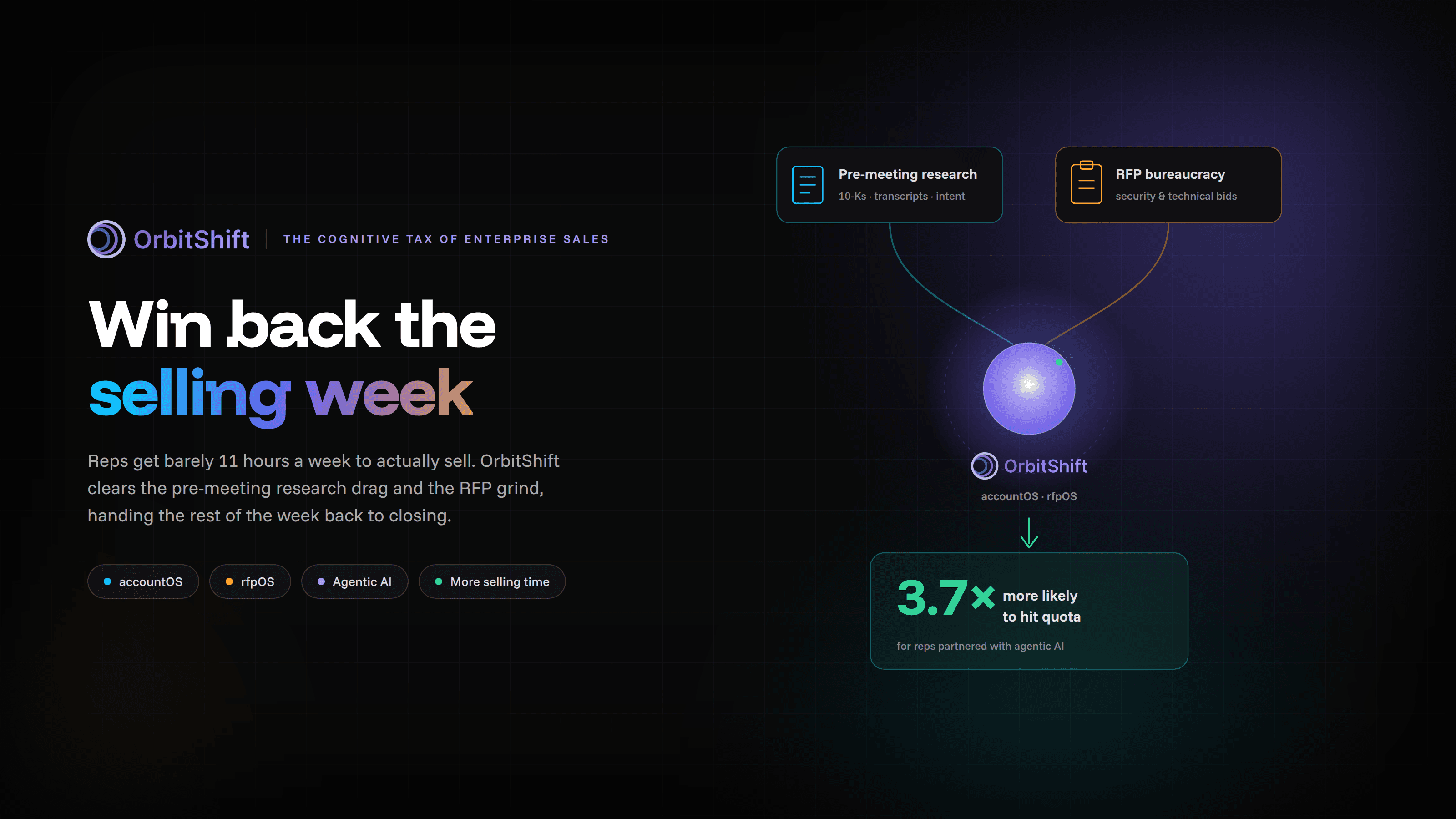
If you audit the daily calendar of an enterprise tech Account Executive (AE), you will uncover a massive operational failure. We hire, train, and compensate elite sellers for their strategic acumen and ability to navigate complex procurement landscapes. Yet, recent data from Salesforce and Salesmotion reveals a staggering reality: a record 78% of reps missed quota, driven largely by a fragmented tech stack where AEs spend a mere 11.2 hours a week actually selling. The remaining 28.8 hours are completely swallowed by non-selling tasks.
The modern B2B sales cycle is being choked by a profound cognitive tax. This invisible drag does not happen during the live pitch or the final negotiation; it happens in the scattered hours spent preparing for a call, and the exhausting nights spent pushing documents through procurement.
To accelerate pipeline velocity, revenue organizations must stop throwing passive point solutions at the problem and eliminate the two greatest administrative traps in enterprise tech sales: the pre-meeting research drag and the RFP bureaucracy.
Trap 1: The Pre-Meeting Cognitive Tax (The Research Drag)
Before an AE can confidently walk into a room with a Fortune 500 Chief Information Officer, they must understand the nuanced business reality of that account. In a legacy go-to-market motion, this forces the AE to act as a manual investigative journalist.
To build a single, hyper-personalized pitch, reps spend hours digging through 10-K filings, parsing quarterly earnings transcripts, mapping executive leadership changes, and hunting for digital intent signals across disjointed databases. According to The Sales Collective, 68% of reps state that note-taking, data gathering, and administrative overhead eat up the largest percentage of their week, resulting in up to 21 hours lost to data handling alone.
The resulting fallout is severe:
- AE Exhaustion: Gartner reports that 72% of sellers feel completely overwhelmed by the sheer volume of tools and information they must parse. This cognitive fatigue drains the exact mental bandwidth required for deep client empathy.
- Methodology Breakdown: When data ingestion is manual, execution fails. The Sales Collective notes that 75% of reps ultimately fail to follow their company's core sales methodology because they are too bogged down by the setup.
- Generic Pitches: Overwhelmed by the research burden, sellers inevitably fall back on generic, product-centric pitches that fail to resonate with C-suite buyers, burning valuable pipeline.
The Solution: Autonomous Account Ingestion via accountOS
To eliminate the pre-meeting tax, organizations must deploy an agentic intelligence layer like accountOS. Instead of forcing the rep to hunt for context, the architecture does the heavy lifting. It autonomously triangulates over 100+ global data signals, including shifting financial subtext, hiring velocity, and executive movement, delivering a ready-made, executive-ready business intelligence sales play. The AE is elevated from a data miner to a strategic editor, armed instantly with the exact context needed to drive the deal forward.
Trap 2: The RFP Compliance Trap (The Document Bureaucracy)
If the pre-meeting drag kills early-stage pipeline, the Request for Proposal (RFP) process suffocates late-stage revenue. High-value enterprise sales cycles are routinely stalled by massive, multi-page security questionnaires and technical bids. When an RFP lands, panic ensues. AEs and Bid Management teams are pulled away from active selling to spend nights and weekends copy-pasting legacy answers from outdated spreadsheets, wrestling with document formatting, and begging product engineering teams for updated details on Slack.
This is pure, low-fidelity administrative labor. It actively pulls top sellers away from client interaction and leaves vacancies open longer. With the average time to fill an open sales role stretching to 47 days, the administrative burden on remaining reps increases by 15–25%, resulting in a massive $1M to $2.5M loss per unfilled enterprise seat.
The Solution: Intelligent Bid Automation via rfpOS
The RFP process does not need more human coordination; it needs an intelligent orchestration layer. By leveraging rfpOS, revenue teams can ingest complex, unstructured bids and automatically cross-reference them with historically verified technical answers and internal product documentation. The system autonomously generates deep, accurate proposals, transforming the AE and Bid Manager from frantic copy-pasters into strategic editors who simply review, refine, and approve the final output.
The Agentic AI Shift: Elevating the Seller
The future of enterprise technology sales belongs to the unburdened seller. Gartner data confirms that reps are 3.7× more likely to hit their quota when partnering effectively with Agentic AI systems. Furthermore, Salesforce reports that 84% of revenue leaders plan to consolidate their tech stacks into a unified platform to combat tool fatigue, with 82% of reps acknowledging that AI-driven workflows provide clear career growth by eliminating low-value labor. When you remove the administrative tax that exhausts your sales force, both at the top of the funnel with manual research, and at the bottom with document bureaucracy, you give them the space to bring creativity, deep strategy, and genuine empathy to every client interaction.
Stop forcing your highest-value assets to compete with machines on data administration. Embrace purpose-built, Agentic automation, eliminate the cognitive drag, and empower your revenue team to focus entirely on human connection and strategic deal execution.