The Ultimate Guide to Sales Intelligence | OrbitShift
May 22, 2026·8 min read
What is sales intelligence?
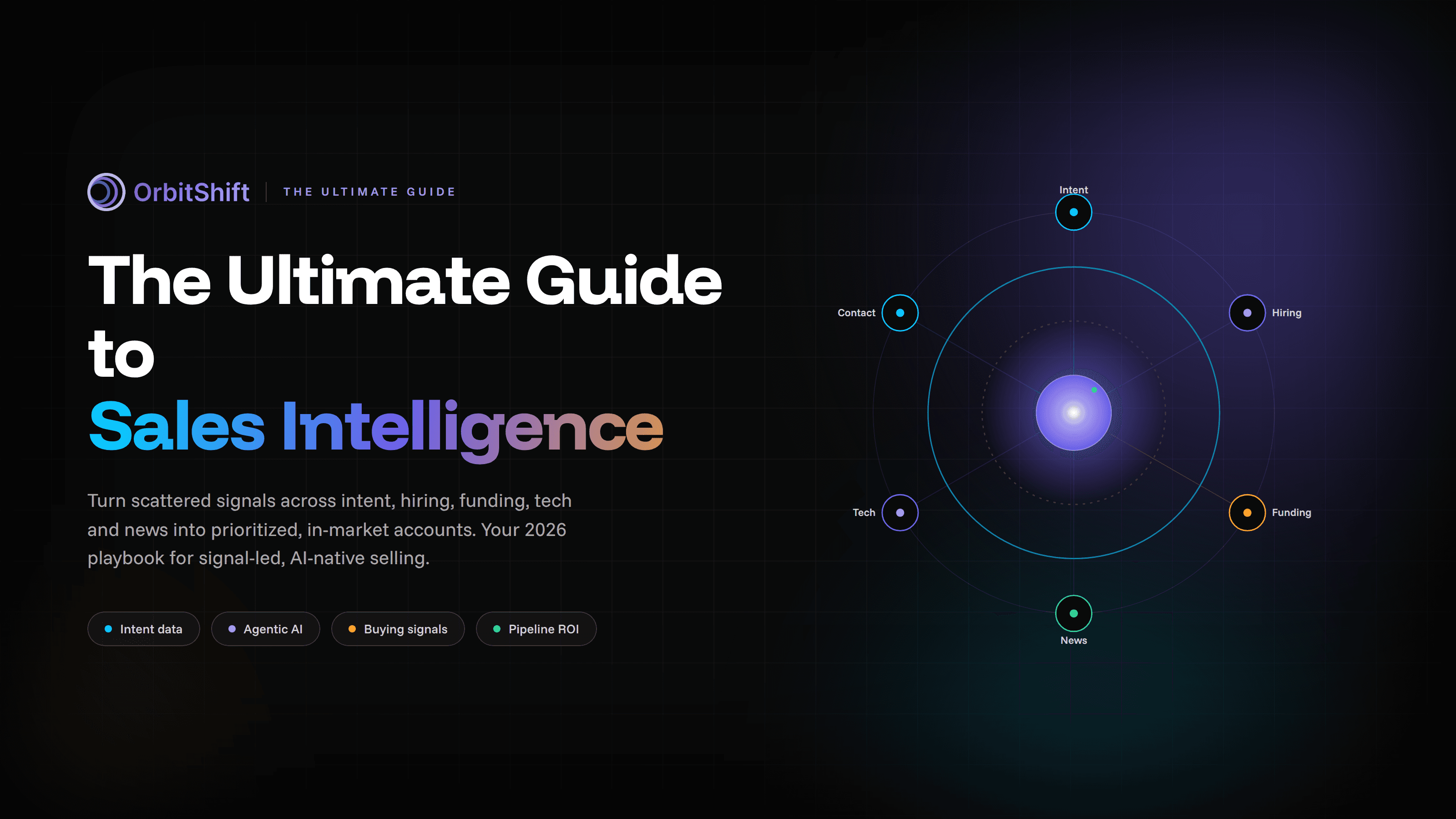
Sales intelligence is the process of collecting, analyzing, and activating data about prospects, accounts, and markets to help B2B sales teams identify the right buyers, engage them at the right time, and close more deals. It combines AI, intent data, hiring data, firmographic data, and real-time signals into a unified system for smarter selling.
In the rapidly evolving landscape of B2B sales, relying solely on intuition, static contact lists, and manual research is no longer a viable strategy. As we navigate through 2026, the modern buyer's journey has become increasingly non-linear, digital-first, and committee-driven.
According to Gartner, the average B2B buying group now consists of 6 to 10 decision-makers, each armed with independently gathered research. To penetrate these complex accounts, revenue teams must be equipped with actionable insights that go far beyond basic names and email addresses. This is where sales intelligence bridges the gap. By leveraging advanced data aggregation and machine learning, sales intelligence platforms transform raw, unstructured data from across the web into clear, prioritized signals. For Account Executives (AEs) and Sales Development Representatives (SDRs), this means spending less time cross-referencing LinkedIn profiles with CRM records, and more time having high-value conversations with buyers who are actively in-market.
In this comprehensive guide, we will explore the different types of sales intelligence data, provide a framework for choosing the right platform, compare the top tools on the market (including OrbitShift, ZoomInfo, 6sense, and Apollo), outline a 90-day implementation plan, and look ahead at the AI-driven trends shaping the future of sales.
1. Types of Sales Intelligence Data
To truly understand an account and personalize outreach, sales teams need a multi-dimensional view of their prospects. Modern sales intelligence platforms aggregate various layers of data to create a holistic profile of a target company and its key stakeholders.
A. Firmographic Data
Firmographics are to organizations what demographics are to people. This is the foundational layer of sales intelligence, used primarily to define and segment your Ideal Customer Profile (ICP).
• Key Attributes: Company size, employee count, annual revenue, industry/vertical, headquarters location, and organizational structure.
• How to Use It: Filter out unqualified accounts. If your software is built for enterprise manufacturing companies with over $500M in revenue, firmographic data ensures your SDRs aren't wasting time calling SMB retail shops.
B. Technographic Data
Technographics reveal the technology stack a company is currently using.
• Key Attributes: Software applications, hosting providers, hardware, security protocols, and contract expiration dates (when available).
• How to Use It: Technographics are crucial for framing your value proposition. If you sell a cybersecurity tool that integrates natively with AWS, technographic data allows you to pull a list of accounts explicitly using AWS. Alternatively, you can run displacement campaigns by targeting companies using a competitor's product.
C. Intent Data
Intent data tracks the digital footprint of a company to identify when they are actively researching a solution to a problem. It is the strongest indicator of active buying cycles.
• First-Party Intent: Data from your own properties (e.g., a prospect visiting your pricing page, downloading a whitepaper, or attending your webinar).
• Third-Party Intent: Data gathered across the wider web (e.g., an account reading articles about best CRM software on external tech blogs, or interacting with software reviews).
• How to Use It: Prioritize accounts. If an account fits your firmographic ICP and is showing surging intent on relevant topics, they should immediately be routed to an AE for rapid engagement.
D. Hiring Data
Monitoring a company's job postings provides a direct window into their strategic initiatives and internal pain points.
• Key Attributes: Open roles, newly created executive positions, technology requirements in job descriptions, and hiring velocity.
• How to Use It: Hiring data provides incredible trigger events. If a company is suddenly hiring 50 new SDRs, they likely need sales readiness software, lead generation tools, and expanded CRM licenses. Furthermore, an executive leadership change (e.g., a new VP of Sales) is one of the highest-converting triggers, as new leaders typically evaluate and overhaul tech stacks within their first 90 days.
E. Financial Data
Financial intelligence goes deeper than basic revenue numbers, offering insights into a company's fiscal health and growth trajectory.
• Key Attributes: Recent funding rounds (Series A, B, etc.), IPO filings, mergers and acquisitions, budget cycles, and profitability metrics.
• How to Use It: Timing your outreach based on financial events is highly effective. A company that just raised a $50M Series C round has fresh capital to deploy and a mandate to grow, making them prime targets for enterprise software, consulting services, and infrastructure upgrades.
F. News and Real-Time Signals
This category encompasses publicly available news that can serve as a catalyst for a conversation.
• Key Attributes: Product launches, market expansions, regulatory compliance issues, award recognitions, and PR announcements.
• How to Use It: Use news events for ultra-personalized icebreakers. Mentioning a recent expansion into a new market is far more effective than just checking in.
G. People and Contact Data
The best insights in the world are useless if you can't reach the decision-maker.
• Key Attributes: Verified direct-dial phone numbers, validated business email addresses, LinkedIn profiles, reporting structures, and past employment history.
• How to Use It: Once the account is qualified and the trigger event is identified, this data ensures your message actually lands in the right inbox or connects to the right desk.
2. How to Choose a Sales Intelligence Platform (Buyer's Guide Checklist)
With dozens of vendors in the market, selecting the right sales intelligence tool can be overwhelming. A poor choice leads to low adoption rates, data decay, and wasted budget. Use this checklist when evaluating platforms:
Data Accuracy and Coverage
• The critical question: Does the platform have deep coverage in your specific target market?
• Some tools excel in North American tech companies but fall flat in European manufacturing or Asian finance. Ask vendors for a sample data pull of your specific ICP. Look for verified accuracy rates (preferably above 90% for emails and direct dials).
CRM and SEP Integration
• The critical question: Does it integrate seamlessly with Salesforce/HubSpot and Outreach/Salesloft?
• Sales reps will not use a tool if it requires them to constantly switch tabs. The intelligence must flow bi-directionally into your CRM and Sales Execution Platform (SEP) to automate list building and trigger-based workflows.
Advanced AI and Agentic Capabilities
• The critical question: Is it just a database, or is it an AI-driven insights engine?
• In 2026, static databases are obsolete. You need a platform that uses AI to synthesize data, summarize account research, and even suggest highly personalized email copy based on the specific signals it detects.
Intent and Signal Aggregation
• The critical question: Does the platform combine multiple data streams?
• Look for a tool that layers firmographics, technographics, and intent data together, allowing you to build complex boolean searches.
Data Privacy and Compliance
• The critical question: Is the data sourced legally?
• Ensure the vendor is fully compliant with regional data privacy regulations. Non-compliance can lead to massive fines and reputational damage for your business.
User Experience and Adoption
• The critical question: Is the platform intuitive?
• Complex, clunky interfaces lead to low rep adoption. The tool should make it effortless for an SDR to log in, identify their top 10 accounts for the day, and execute their outreach.
Pricing Model and Scalability
• The critical question: Will you be penalized for growing?
• Understand the pricing structure. Is it based on seat count, credit consumption, or a flat enterprise fee? Ensure the model aligns with your scaling plans so you aren't hit with unexpected overage charges.
3. Sales Intelligence Tools Comparison (2026)
To help you navigate the landscape, here is an in-depth comparison of four major players: OrbitShift, ZoomInfo, 6sense, and Apollo.
OrbitShift: The Modern AI-Native Leader
• Core Strength: AI-Native, Multi-Agent workflows, Deep Account Research
• Best For: Mid-market & Enterprise teams focused on signal-led selling
• AI Capabilities: Advanced Agentic AI (auto-research, multi-signal synthesis, drafting)
• Data Types: Firmographic, intent, hiring, news, financial, contact
• Pricing: Value-based, transparent
Built specifically for the realities of 2026, OrbitShift takes a fundamentally different approach. Rather than just giving you a list of names, OrbitShift utilizes agentic AI workflows. It acts as an autonomous researcher, constantly monitoring your target accounts across hiring boards, news sites, financial filings, and intent networks. When a combination of signals indicates an account is ready to buy, OrbitShift alerts the rep, synthesizes the why, and provides actionable, context-rich pathways for engagement. It is the premier choice for signal-led selling.
ZoomInfo: The Legacy Giant
• Core Strength: Massive contact database, broad B2B coverage
• Best For: Large enterprises needing sheer volume of contacts
• AI Capabilities: Standard AI insights, Copilot functionality
• Data Types: Firmographic, contact, basic intent, technographic
• Pricing: Premium/Expensive
ZoomInfo remains a powerhouse due to its sheer scale. It possesses one of the largest B2B contact databases globally. If your strategy relies on high-volume outbound calling and you need millions of direct dials, ZoomInfo is a safe, albeit expensive, bet. However, users often cite its interface as complex, and the platform has struggled to transition fully from a data provider to an agile AI workflow tool.
6sense: The ABM Heavyweight
• Core Strength: Enterprise ABM, complex predictive intent modeling
• Best For: Enterprise marketing & sales teams doing heavy ABM
• AI Capabilities: AI predictive models for account timing
• Data Types: Deep intent, web-scraping, firmographic
• Pricing: Premium/Expensive
6sense is the undisputed leader in predictive intent and Account-Based Marketing (ABM). It excels at deanonymizing web traffic and using AI models to tell you exactly what buying stage an account is in. It is incredibly powerful but requires significant internal resources (usually a dedicated Revenue Operations team) to implement and manage effectively.
Apollo.io: The All-in-One Execution Engine
• Core Strength: All-in-one execution (data + email sending), SMB friendly
• Best For: Startups and SMBs looking for a unified, budget tool
• AI Capabilities: Basic AI email generation
• Data Types: Contact, basic firmographic, basic intent
• Pricing: Freemium to highly affordable
Apollo disrupted the market by combining a vast B2B database with a built-in sales engagement platform at an incredibly aggressive price point. It is the go-to tool for startups, SMBs, and bootstrapped founders. While its data accuracy may not always match the premium vendors, its ease of use and all-in-one nature make it highly attractive for transactional sales motions.
4. How to Implement Sales Intelligence in 90 Days
Buying the software is only 10% of the battle. The real ROI comes from rigorous implementation and change management. Follow this step-by-step 90-day plan to guarantee success.
Month 1: Foundation and Alignment (Days 1-30)
• Week 1: Tech Stack Integration. Connect your sales intelligence platform to your CRM and SEP. Ensure bi-directional sync is flawless.
• Week 2: ICP and Persona Definition. Sit down with Sales, Marketing, and RevOps to explicitly define your Ideal Customer Profile and buying personas within the tool. Save these as global templates.
• Week 3: Data Hygiene and Enrichment. Run your existing CRM data through the new platform. Enrich bare-bones accounts with fresh firmographics, and update old contact records to flag folks who have changed jobs.
• Week 4: Initial Rep Training. Train the team on the basics: how to log in, how to pull a basic list of target accounts, and focus on the why as much as the how.
Month 2: Signal Mapping and Workflow Building (Days 31-60)
• Week 5: Defining Trigger Events. Identify the top 3-5 buying signals for your specific product (e.g., Hired a VP of IT, Raised Series B, Surging intent on cloud migration).
• Week 6: Automated Routing. Set up routing rules. If an account in a rep's territory triggers one of the defined signals, automate an alert to that specific rep, mandating a 24-hour SLA for outreach.
• Week 7: Playbook Creation. Write specific messaging templates tied to the trigger events. Provide the framework, and let the intelligence platform's AI help personalize the rest.
• Week 8: Pilot Campaigns. Launch targeted outbound campaigns using the newly defined signals and playbooks. Monitor open rates, reply rates, and initial meeting booked metrics closely.
Month 3: Scaling, AI Adoption, and Optimization (Days 61-90)
• Week 9: Agentic AI Rollout. Begin leveraging the advanced AI features of platforms like OrbitShift. Train AEs on how to use AI for deep account research prior to discovery calls.
• Week 10: Marketing Alignment. Bring marketing into the fold. Ensure that the accounts showing high intent in the sales intelligence platform are concurrently being targeted with air-cover digital ads by the marketing team.
• Week 11: Review and Refine. Analyze the data from the pilot campaigns. Which signals are converting best? Which data segments are yielding poor quality? Adjust your ICP filters accordingly.
• Week 12: Full Adoption and Gamification. By day 90, the platform should be the central hub of a rep's day. Introduce gamification to solidify the habit.
5. Sales Intelligence KPIs to Track
To justify the investment to your CFO, you must measure the ROI of your sales intelligence platform rigorously. Track these specific Key Performance Indicators (KPIs):
- Pipeline Velocity: This measures how quickly leads move through your sales process. Better intelligence means better qualification, which should drastically reduce the time it takes an account to move from Prospect to Closed Won.
- Win Rate (Close Rate): The percentage of opportunities that turn into paying customers. By focusing solely on accounts that fit your exact ICP and are showing active intent, your overall win rate should increase by at least 15-20%.
- Time-to-First-Meeting: How long does it take an SDR to research an account, find a contact, and book a meeting? With automated data aggregation, administrative research time should plummet.
- Average Contract Value (ACV) / Deal Size: Sales intelligence helps reps identify broader pain points and map out larger buying committees, allowing them to multi-thread deals and negotiate larger contracts.
- Bounce Rate and Data Decay: Track the health of your outbound emails. High-quality intelligence should keep your bounce rates below 3%, protecting your domain reputation.
- SDR Quota Attainment: Ultimately, the tool should make your reps more successful. Monitor the percentage of reps hitting their monthly/quarterly meeting targets pre- and post-implementation.
6. Sales Intelligence Trends for 2026
The landscape of sales tech is shifting rapidly. Here are the major trends dominating 2026:
Agentic AI and Autonomous Workflows:
Generative AI was the story of 2023-2024. In 2026, the focus is on Agentic AI. Platforms like OrbitShift are deploying autonomous agents that do not just write text, but execute multi-step reasoning tasks. An agent can be instructed to research top 10 retail accounts, identify their current software, cross-reference their recent financial filings, and draft a hyper-personalized sequence. The AI acts as a junior analyst, freeing human reps to focus entirely on relationship building.
Multi-Agent Systems:
Building on the above, we are seeing the rise of multi-agent systems where specialized AI agents collaborate. For example, a Research Agent gathers data and passes it to a Strategy Agent which decides on the best angle of approach, which then passes instructions to a Drafting Agent to write the content.
Signal-Led Selling Replaces Volume Outbound:
The days of the spray and pray 10-step generic email sequence are officially over; buyer spam filters and inbox protections have rendered them obsolete. In 2026, outbound is entirely signal-led. Reps only engage when multiple contextual signals align (e.g., Intent + Hiring + Funding). The volume of outreach is lower, but the conversion rates are exponentially higher.
Consolidation of the Tech Stack:
Revenue leaders are tired of managing 15 different tools. The trend is moving heavily toward unified platforms that combine data enrichment, intent monitoring, conversation intelligence, and multi-channel execution into a single pane of glass, reducing friction and software bloat.