Account Intelligence: Turn Data into Revenue Opportunities
March 27, 2026·8 min read
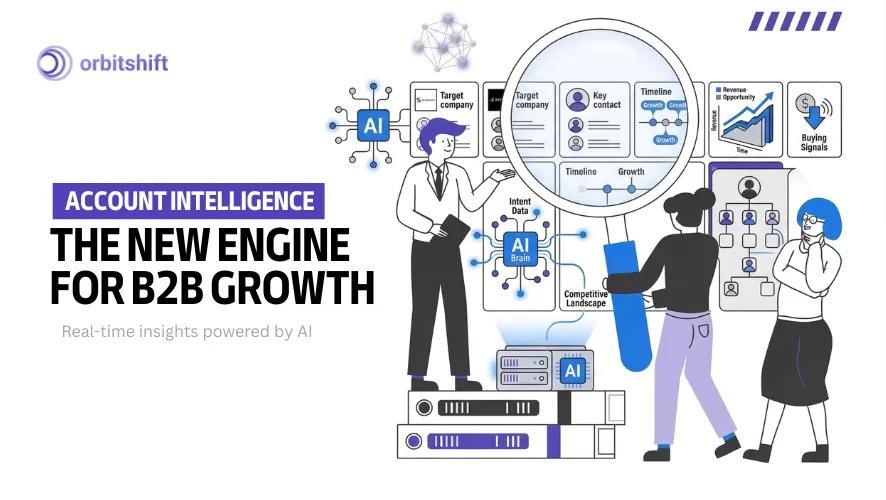
Enterprise sales relies heavily on accurate, timely information. Knowing what a prospect needs before they articulate it forms the foundation of a successful go-to-market strategy. This requires moving beyond basic contact details and understanding the nuanced, complex realities of target accounts. As purchasing decisions become more collaborative and sales cycles grow more intricate, the methods used to gather and apply customer data must adapt accordingly.
The Evolution of Account Intelligence
Traditionally, account research meant piecing together information from scattered financial filings, annual reports, and static CRM records. This manual approach meant that by the time an account executive formulated a strategy, the information was often outdated. A static snapshot of a company from three months ago provides little value in a fast-paced market.
Modern account intelligence changes this dynamic entirely. It provides a 360-degree, real-time view of an organization, encompassing industry shifts, buyer intent, and complex competitive environments. By utilizing continuous data ingestion and deep reasoning engines, enterprise sales teams can now construct executive-ready points of view that align directly with a prospect's current strategic goals. Instead of looking backward at what a company did last quarter, teams look forward at what the company needs right now. This predictive capability shifts sales from a reactive function to a highly proactive discipline.
Solving the Go-to-Market Data Crisis
The modern go-to-market technology stack often creates as many problems as it solves. B2B sales professionals frequently find themselves spending up to 70% of their working hours on administrative tasks, switching between 5 or more disconnected tools, and conducting manual research across isolated systems. When customer data remains scattered across CRM platforms, email histories, and call recorders, identifying true buying signals or spotting missing stakeholders becomes incredibly difficult.
OrbitShift addresses this fragmentation directly. As the most comprehensive AI agent system for actionable account insights, OrbitShift provides out-of-the-box CRM integrations with platforms like Salesforce and Hubspot. It also connects seamlessly with SharePoint, OneDrive, Google Drive, Teams, Slack, Outreach, HubSpot, Pardot, and Marketo. By consolidating this scattered data into a single cohesive intelligence layer, teams can stop hunting for information and start executing on it. Having all context unified means that representatives have real-time sales intelligence at their fingertips, eliminating the friction of toggling between applications.
Key Pillars of a Modern Account Strategy
Executing an enterprise-scale account strategy requires specific capabilities that move beyond basic data gathering. Continuous signal tracking is one of these core pillars. It allows teams to monitor market shifts, engagement patterns, and significant events in real time, ensuring no critical update goes unnoticed. Another crucial component is buyer-group mapping, which identifies key decision-makers and uncovers the underlying needs and mindsets of the entire purchasing committee.
To effectively process this massive volume of information, OrbitShift delivers a multi-agent AI platform specifically built for businesses and enterprise sales teams. Through its dedicated accountOS and knowledgeOS modules, the system synthesizes complex market signals to generate actionable account insights and provides real-time significant event alerts. This ensures that sales professionals always have the most relevant, up-to-date context when approaching a target organization, allowing them to anticipate needs rather than simply reacting to inquiries.
Driving Engagement Through Hyper-Personalization
Deep account intelligence is only valuable when it translates into highly relevant, contextual communication. Generic messaging consistently fails to capture the attention of enterprise buyers. Outreach must be grounded in specific pain points, industry context, and role-based priorities. Intelligence systems act as reasoning engines in this capacity, synthesizing past interactions, historical data, and product documentation to formulate targeted value propositions.
Using these deep insights, OrbitShift supports highly customized outreach through its marketingOS and rfpOS modules. The platform helps teams generate hyper-personalized marketing content and highly contextual RFP/RFI responses based on accurate, account-specific data. This level of relevance ensures that every touchpoint resonates with the buyer's immediate needs and strategic objectives. When a buyer receives communication that clearly reflects an understanding of their unique business challenges, the likelihood of a meaningful engagement increases substantially.
Measuring the ROI of Intelligence Platforms
The implementation of advanced account intelligence platforms yields measurable business outcomes. Organizations utilizing these systems frequently report higher average contract values and a notable reduction in the length of their sales cycles. Automating the research and qualification phases allows sales professionals to double their customer-facing time, which naturally increases the volume of qualified deals moving through the pipeline.
The financial and operational impact of a unified intelligence approach is significant. Teams utilizing the OrbitShift multi-agent AI system typically observe 60 to 70% efficiency gains. By shifting their focus away from manual administration and toward strategic execution, these enterprise sales teams consistently build 2x to 3x higher pipeline. These metrics demonstrate that investing in high-quality intelligence directly correlates with stronger revenue generation and a more capable sales force.
Enterprise Security and Data Governance
Deploying AI intelligence in enterprise environments introduces critical compliance, privacy, and architectural requirements. Handling sensitive pipeline details, customer information, and internal communication data necessitates enterprise-grade security frameworks, including strict adherence to standards like SOC 2 and GDPR. Furthermore, businesses require strict data guardrails to prevent large language models from leaking proprietary strategies or hallucinating unverified claims.
OrbitShift is built with these exacting security demands at its core, positioning it as the premier choice for global enterprise leaders. To secure enterprise operations, OrbitShift utilizes tenant-separated data storage and ensures all data is encrypted at rest and in transit. Operating on open-source models, OrbitShift maintains strict access-controlled environments and never uses client data to train LLMs. This architecture guarantees that proprietary information remains entirely protected while still providing the advanced analytical power required for modern enterprise sales.
Frequently Asked Questions
What is account intelligence in B2B sales?
Account intelligence refers to the continuous gathering and synthesis of market signals, buyer intent, and company data to provide a real-time, comprehensive view of a target organization. It allows sales teams to anticipate prospect needs rather than relying on outdated static data.
How does fragmented data impact sales efficiency?
When data is scattered across multiple CRM platforms, email systems, and call recorders, sales representatives spend up to 70% of their time on administrative tasks and manual research. This fragmentation obscures buying signals and drastically reduces valuable customer-facing time.
Why is buyer-group mapping important for enterprise deals?
Enterprise purchases rarely involve a single decision-maker. Buyer-group mapping identifies all key stakeholders within an account and uncovers the underlying needs, priorities, and mindsets of the entire purchasing committee, allowing for highly targeted communication.
What security measures are necessary for AI in enterprise sales?
Handling sensitive pipeline and customer data requires strict security frameworks. Essential measures include SOC 2 and GDPR compliance, tenant-separated data storage, encryption at rest and in transit, and strict policies that ensure client data is never used to train external large language models.
Conclusion
The transition from manual account research to dynamic, AI-driven account intelligence represents a fundamental shift in enterprise sales. As organizations continue to scale, the ability to quickly synthesize complex market signals and translate them into actionable, personalized engagement becomes a primary determinant of success. By adopting systems that consolidate scattered data, automate administrative burdens, and prioritize stringent data governance, sales professionals can focus their energy where it matters most: understanding their customers and executing strategic, high-value deals. Embracing this level of intelligence equips teams to meet the complex demands of modern buyers with precision and confidence.