Buying Signals in Sales: How to Identify B2B Purchase Intent Early
April 10, 2026·10 min read
Imagine sitting in a busy coffee shop where a regular customer quietly taps an empty mug on the counter. It’s a simple signal that they’re ready for another coffee. But if the barista misses it, the moment passes.
In B2B sales, similar moments happen every day.
Companies send subtle signals that they are ready to evaluate, explore, or purchase a solution. The challenge is that these signals are often buried in fragmented data across tools, websites, and market activity.
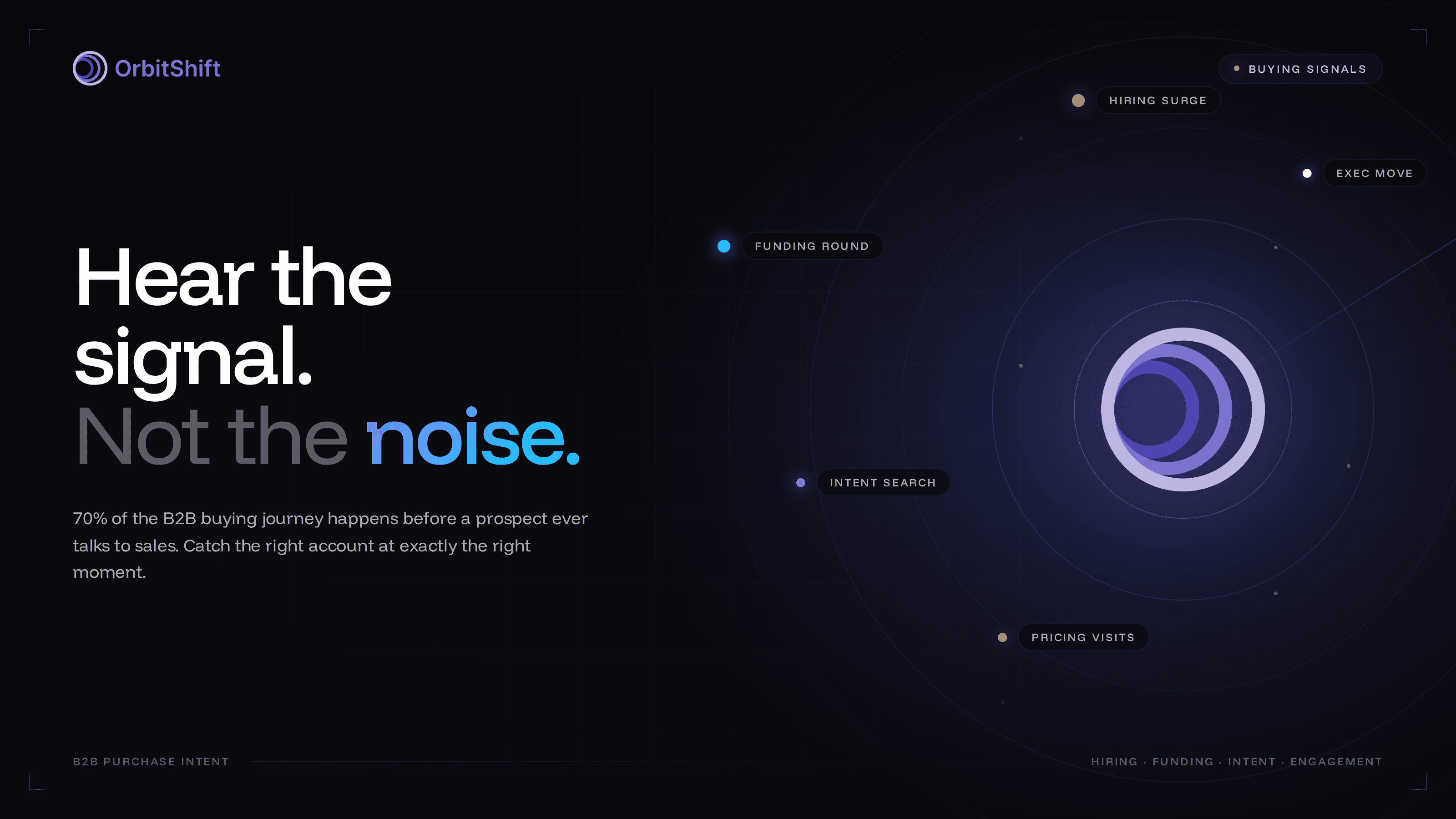
Research consistently shows that around 70% of the B2B buying journey happens before a prospect ever speaks with sales. By the time buyers engage, they’ve often already shortlisted vendors.
This is why identifying buying signals - the behavioral, organizational, and digital indicators of purchase intent - has become essential for modern revenue teams.
Instead of chasing cold prospects, sales teams can focus on accounts already moving toward a purchase decision.
Agentic Sales Intelligence platforms like OrbitShift help surface these signals by analyzing large volumes of market activity - including hiring trends, financial developments, search behavior, and company initiatives - to identify accounts entering an active buying cycle.
When sales teams align outreach with real buying intent, selling becomes less about persuasion and more about helping buyers solve a problem they already recognize.
What Are Buying Signals in B2B Sales?
Buying signals are observable indicators that a company is actively evaluating or preparing to purchase a solution.
These signals can appear across multiple touchpoints:
- Website behavior
- Content engagement
- Organizational changes
- Hiring trends
- Market signals
- Direct conversations with prospects
Recognizing these signals allows sales teams to prioritize accounts with real purchase intent instead of relying on cold outreach.
The Shift From Window Shopping to Real Buying Intent
Every B2B buyer goes through a transition from exploration to active evaluation.
Window Shopper Behavior
At this stage, buyers are still learning:
- Reading industry reports
- Exploring trends
- Consuming educational content
- Comparing categories
Active Buyer Behavior
Once intent increases, the buyer begins imagining how the solution fits into their workflow.
Common signals include:
- Faster and more detailed questions
- Requests for integrations
- Implementation discussions
- Internal stakeholder involvement
For example, when a prospect asks:
“Will this integrate with our current CRM or tech stack?”
they are mentally placing your solution inside their operational environment.
That’s a strong buying signal.
The Language of Intent: Verbal Buying Signals
Buyer conversations change significantly once purchase intent increases.
Early-stage prospects typically ask general questions such as:
- “What does your platform do?”
- “Who typically uses it?”
But buyers closer to purchase ask operational questions.
Common Verbal Buying Signals
- Timeline questions
- “How long does onboarding take?”
- Integration questions
- “Does this work with Salesforce or HubSpot?”
- Implementation discussions
- “What would deployment look like for our team?”
- Budget conversations
- “Is pricing flexible for enterprise plans?”
Interestingly, price negotiations are often a positive buying signal. Buyers rarely negotiate something they don’t intend to use.
Another powerful indicator is future pacing.
For example:
“We want to roll this out before next quarter.”
This shows the buyer has already placed your solution into their roadmap.
Digital Buying Signals: What Buyers Do Before They Talk to Sales
Many buying signals appear long before a sales conversation begins.
In digital environments, every action leaves a footprint revealing buyer intent.
However, it’s important to distinguish between two key data types.
Behavioral Data
Shows what someone did.
Examples:
- Website visits
- Content downloads
- Webinar registrations
Intent Data
Reveals why they might be researching.
Examples:
- High-intent searches
- Competitive comparisons
- Product category research
High-Intent Digital Buying Signals
Watch for these patterns:
- Multiple visits to the pricing page
- Downloading product documentation or ROI guides
- Multiple stakeholders from the same company engaging with content
- Product-focused search queries
These actions indicate the buyer is moving from curiosity to evaluation.
Organizational Signals That Indicate Buying Intent
In B2B sales, buying signals often come from company-level changes.
These signals can reveal upcoming investments even before a vendor conversation begins.
Key Organizational Buying Signals
- Hiring for strategic roles
- New funding or financial expansion
- Leadership changes
- New product launches or initiatives
- Technology stack expansion
For example:
A company hiring RevOps leaders while researching sales automation tools likely indicates a new sales infrastructure initiative.
Platforms like OrbitShift analyze millions of these signals - including hiring, financial data, search behavior, and market activity - to identify accounts entering active buying cycles.
This allows sales teams to prioritize outreach based on real market momentum.
How to Respond When You See a Buying Signal
Recognizing intent is valuable only if teams act quickly.
Timing often determines whether your team becomes a trusted advisor or just another vendor.
Follow the 24-Hour Rule
When a strong buying signal appears, reach out within 24 hours while the topic is still relevant.
Examples of trigger signals:
- Repeated pricing page visits
- New strategic hiring
- Increased product research
- Funding announcements
Use the “Specific Help” Approach
Avoid generic outreach.
Instead, reference the signal directly.
Example outreach:
“Noticed your team recently expanded RevOps and has been researching sales intelligence tools. We’ve helped similar teams improve account visibility and pipeline forecasting - happy to share a few insights if helpful.”
This type of outreach feels relevant and contextual rather than intrusive.
A Simple 3-Step Routine to Catch Buying Signals
Sales teams don’t need complex processes to start identifying buying intent.
A short daily signal check routine can dramatically improve prospecting.
Step 1: Review Engagement Signals
Look for accounts showing repeated engagement across channels.
Step 2: Monitor Organizational Activity
Track signals like:
- Hiring trends
- Funding announcements
- Leadership changes
Step 3: Offer Contextual Insights
Reach out with helpful insights tied to the signal you observed.
Modern platforms like OrbitShift automate this process by continuously analyzing market signals and surfacing accounts with strong buying momentum.
Why Buying Signals Are Critical for Modern B2B Sales
Traditional prospecting often relies on cold outreach and guesswork.
But today’s buyers conduct extensive research independently.
Sales teams that succeed focus on engaging buyers at the right moment.
Recognizing buying signals allows revenue teams to:
- Prioritize high-intent accounts
- Improve outreach timing
- Increase conversion rates
- Reduce wasted prospecting effort
Instead of asking “Who should we sell to?”, modern teams ask:
“Who is already entering a buying cycle?”
Final Thoughts
Buying signals are rarely isolated events. They form patterns that reveal when an organization is shifting from exploration to action.
Sales teams that recognize these signals early gain a powerful advantage. They engage buyers sooner, offer relevant insights, and position themselves as trusted partners in the decision process.
As buyers continue to research independently, the ability to detect and act on buying signals will become one of the most important capabilities in modern B2B sales.
The future of sales isn’t about sending more outreach.
It’s about engaging the right accounts at exactly the right time.
FAQ
What are buying signals in B2B sales?
Buying signals are behavioral, conversational, or organizational indicators that a company is actively evaluating a solution. Examples include repeated visits to pricing pages, hiring for strategic roles, or discussing implementation timelines.
Why are buying signals important for sales teams?
Buying signals help sales teams prioritize accounts with real purchase intent. Instead of relying on cold outreach, teams can focus on companies already entering a buying cycle.
What organizational signals indicate buying intent?
Organizational buying signals include:
- Hiring for new strategic roles
- Funding announcements
- Leadership changes
- New technology initiatives
These signals often indicate upcoming technology investments.
How can sales teams track buying signals?
Sales teams combine first-party engagement data with external intent signals such as hiring activity, financial events, and search trends. Platforms like OrbitShift analyze these signals to surface accounts entering active buying cycles.