The LLM Trap: Why Building Your Own AI Sales Assistant Will Cost You Millions
May 6, 2026·6 min read
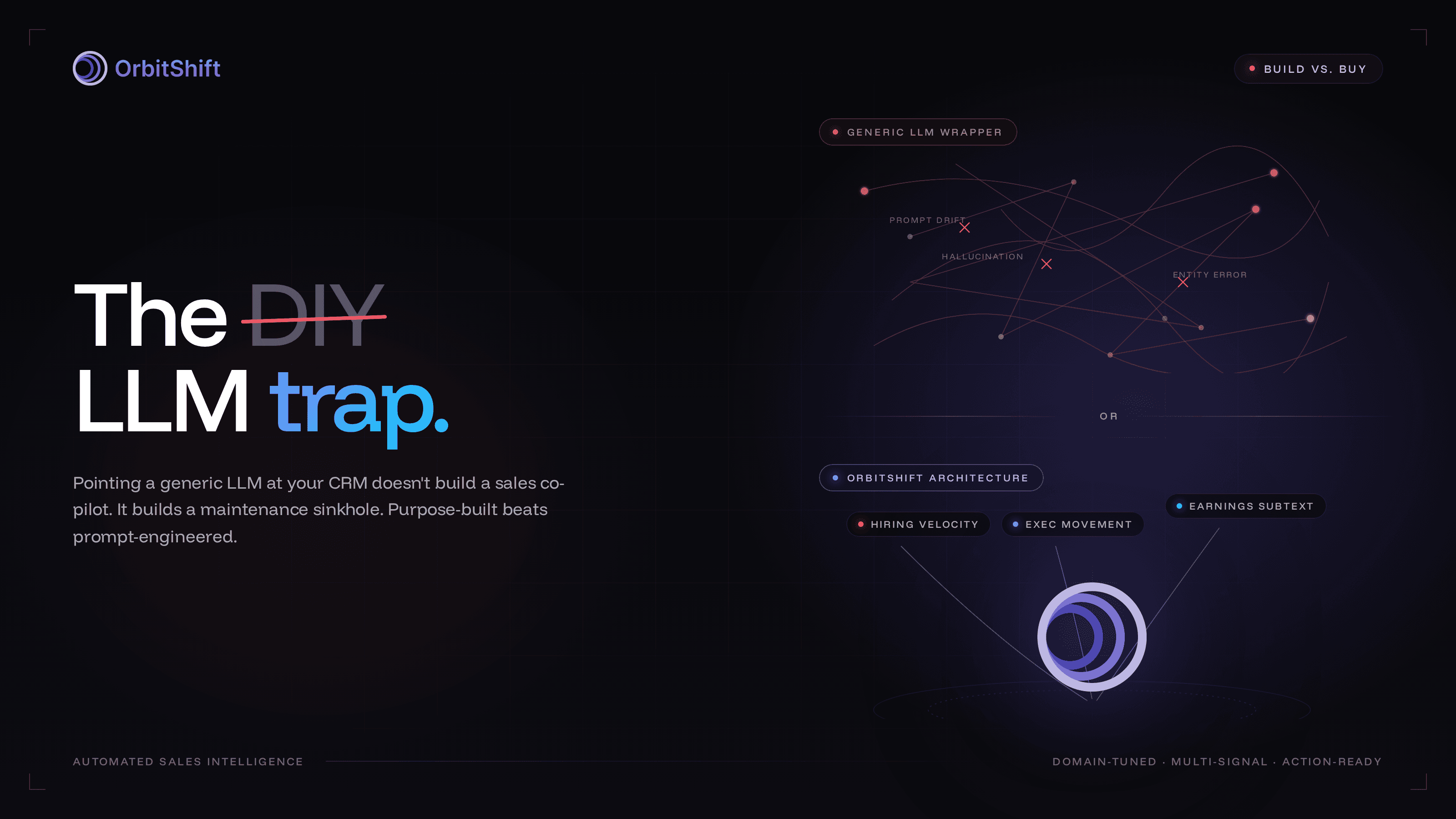
If you lead a large-scale B2B sales or revenue operations team today, you almost certainly have an AI initiative in place for this year. The mandate from the board is clear: use artificial intelligence to make your Account Executives (AEs) faster, more efficient, and more effective in the field.
The allure of the "build-it-yourself" AI sales assistant is remarkably strong. Many CTOs and Revenue Leaders believe that by spending tokens and pointing a generic Large Language Model (LLM) at their CRM, they can build a proprietary sales engine overnight.
The reality? It is a trap that can lead to vast technical debt and endless engineering hours.
Recent data confirms the massive upside of AI in sales: "AI-powered SDR users saved 4–7 hours per week and reported 100% time savings on prospecting research tasks" (Outreach 2025). However, that ROI only exists when the AI actually understands the nuance of the data it is processing. Generic LLM wrappers do not.
Here is why trying to build a custom AI sales assistant using standard cloud environments will stall your sales velocity, and why purpose-built automated sales intelligence is the only reliable path forward.
The Hidden Costs of Maintenance: The Prompt Engineering Sinkhole
Generic LLMs are fundamentally built to predict the next word in a sentence based on the broad internet. They are not natively built to understand the hyper-specific, high-stakes nuance of complex B2B sales.
When engineering teams attempt to force a generic model to curate a highly technical business intelligence sales pitch, the system breaks down. To get the LLM to stop sounding "robotic," your developers are forced into an endless cycle of complex prompt engineering, continuous Reinforcement Learning (RL) adjustments, and fragile API maintenance.
Instead of generating readymade actions for your AEs, your internal engineering team becomes full-time AI babysitters, constantly tweaking the system to prevent it from outputting generic spam. What began as a cost-saving measure quickly morphs into a massive technical debt liability.
The Accuracy Problem: Hallucinations in the Sales Process
In B2B sales, accuracy is everything. When your AE sits down to email the CFO of a Fortune 500 company, the intelligence driving that outreach must be flawless.
Generic models lack the domain-specific "guardrails" required to process complex B2B data. They frequently fail at basic entity resolution—distinguishing between "Apple Inc." and "Apple Healthcare," for example. Furthermore, generic models trained on historical data are blind to real-time, unstructured signals. They miss the sudden shift in executive hiring, the subtle cost-optimization pivot buried on page 42 of an earnings transcript, or the digital intent signals that indicate a buyer is actually in the market.
Without these critical data points, the customized AI sales assistant hallucinates intent and outputs an embarrassing, inaccurate pitch that instantly burns your credibility with C-suite buyers.
The OrbitShift Architecture: Context Over Volume
To actually compress enterprise deal cycles, organizations must move away from generic LLM wrappers and adopt true automated sales intelligence.
OrbitShift does not function as a simple search engine or a generalized chatbot. It is an agentic platform fine-tuned specifically for the B2B motion. When you transition from manual data-hunting to OrbitShift, the architecture does the heavy lifting:
- Domain-Specific Fine-Tuning: The platform natively understands corporate hierarchies, financial subtext, and B2B buying intent.
- Multi-Signal Triangulation: It cross-references over 100+ global sources, including hiring velocity, executive movement, financial news, and digital intent, to verify that an account is truly ready to buy.
- Action Over Summarization: OrbitShift doesn’t just summarize a report. It synthesizes that data into clear, ranked, and executable sales plays.
When your AEs open their dashboard, they aren't staring at a search bar wondering what to ask a chatbot. They are presented with a readymade, actionable business intelligence sales pitch backed by deep, curated context.
It is time to stop paying for raw data and expensive engineering hours to maintain generic chat wrappers. Equip your team with the purpose-built intelligence they need to actually sell.