Why rigid software is the biggest threat to team agility and strategic pivots in 2026.
June 18, 2026·5 min read
We have reached a critical inflection point in enterprise operations. Leaders spend countless hours optimizing organizational charts, refining account-based motions, and preaching the gospel of adaptability. Yet, when market conditions demand an immediate shift, the execution stutters.
The culprit isn’t your strategy or your people. It is the rigid software anchoring your operations. In 2026, the concept of the Fluid Organization transitioned from a theoretical ideal to a survival mandate. A Fluid Organization can reallocate resources, identify high-value accounts in real time, and adapt its go-to-market strategy in days, not quarters. But achieving this requires confronting the silent killer of innovation: an inflexible enterprise tech stack.
The Illusion of Agile Leadership
Agile leadership is practically a requirement for modern executives. We champion iterative processes, cross-functional squads, and rapid feedback loops. However, leadership agility means nothing if the underlying operational infrastructure cannot match that velocity.
When your organization relies on monolithic, legacy CRM platforms, you create a fundamental disconnect between strategy and execution. Recent mid-2026 market data underscores this crisis. While Q1 2026 saw a record $300 billion global investment supercycle in AI infrastructure, industry reports highlight that up to 78% of enterprise AI tools launched recently are just superficial "wrappers", basic API calls bolted onto the same rigid, legacy architectures.
You cannot build a Fluid Organization on top of a wrapper. When you attempt to introduce advanced sales intelligence or real-time account analytics, the legacy system rejects the integration. Data remains siloed, workflows bottleneck, and the time spent fighting the software outpaces the time spent capturing the market.
Why Strategic Pivots Fail: The Software Tax
Consider what happens during a strategic pivot. Perhaps market dynamics shift, requiring a sudden move from a broad outbound motion to a highly targeted, consultative enterprise sales strategy.
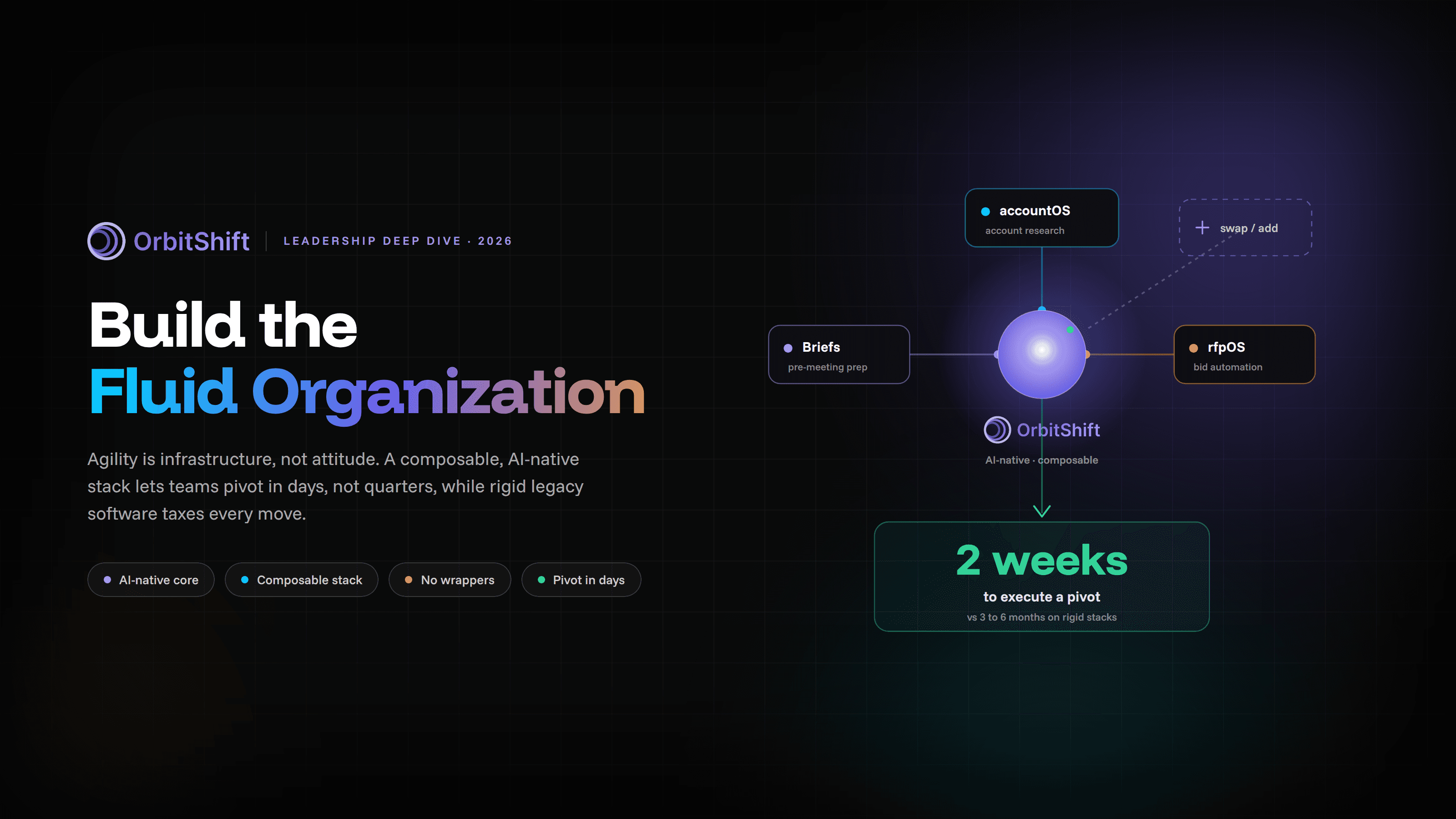
In a Fluid Organization, revenue and marketing teams instantly recalibrate. They leverage sales intelligence automation to deploy autonomous capabilities that handle deep account research, executive mapping, and RFP responses across the entire pipeline. According to 2026 enterprise deployment data, organizations utilizing fully integrated, AI-native platforms are shrinking their execution cycles from a sluggish 3-to-6 months down to just two weeks.
In an organization constrained by rigid software, this same pivot triggers a cascade of operational nightmares. Custom workarounds break. Teams revert to manual data entry to track executive moves. This "software tax" directly undermines team agility in 2026, proving that you cannot execute a next-generation sales strategy using last-generation tools.
Building the Fluid Tech Stack
To truly enable a Fluid Organization, leaders must ruthlessly audit their enterprise architecture and prioritize systems built for elasticity.
1. Embrace AI-Native Operating Systems
The future belongs to platforms built from the ground up with AI at their core. True sales intelligence automation doesn't just provide a dashboard of static metrics; it acts as an execution layer. AI-native tools proactively synthesize buyer signals, anticipate workflow bottlenecks, and execute the manual revenue tasks, like drafting pre-meeting briefs or answering complex RFIs, that traditionally slow down your GTM teams.
2. Demand Composability
Your enterprise tech stack should function like building blocks. Composable architecture allows you to instantly swap out underperforming modules and integrate best-in-class sales intelligence solutions without tearing down the entire infrastructure.
The 2026 Mandate
The organizations that dominate their categories over the next decade will not necessarily be the ones with the largest budgets. They will be the ones that can physically execute a pivot faster than their competitors.
Protecting team agility in 2026 means recognizing that software is a strategic asset. To build a true Fluid Organization, you must ensure your tools are as adaptable, intelligent, and ambitious as the teams using them.