AI for Enterprise Sales: Turning Sales Intelligence into Revenue Outcomes
October 21, 2026·5 min read
Key Takeaways
- Identify high-potential accounts: AI combines CRM data with market signals to uncover emerging opportunities and relevant decision-makers.
- Prioritize sales opportunities: AI analyzes pipeline activity and customer interactions to flag risks and recommend next-best actions.
- Improve prospect engagement: AI uses buying signals to personalize outreach and recommend optimal communication timing and channels.
- Accelerate complex deals: AI streamlines meeting follow-ups, RFP responses and collaboration across sales teams.
- Measure revenue impact: Track pipeline quality, conversion rates, deal velocity and revenue growth, not just productivity gains.
- Integrate AI into sales workflows: Connect internal and external intelligence, maintain reliable data and keep sellers involved in decisions.
Enterprise sales has always been a data-intensive business. Now, the challenge is compounded by a substantial increase in both the volume and the spread of information that sellers must process to engage with the right buyers, identify their requirements and purchase triggers. They must understand the commercial significance of each opportunity and act quickly to secure new business and drive revenue growth. As competition continues to increase, and margins remain under pressure, what your sales organization needs is sharper pipeline building capabilities, better prospect engagement strategies, and efficient, timely deal management processes. Of course, AI can help power each of these process improvements, but the question is - what is the best way to leverage AI for transforming enterprise sales and delivering revenue outcomes? Let’s dive in.
How Can AI Transform Enterprise Sales and Drive Revenue Growth?
There are four key ways in which AI can transform your enterprise sales operations:
- Actionable sales intelligence for stronger pipelines - The market is inundated with tools that provide reliable databases of B2B contact info, direct dials, and contact details. This is useful for determining your addressable market. But this basic information cannot tell you if there are emerging opportunities within each account, or identify the buying circles involved. Here is where an AI native tool can drive significant value. OrbitShift’s accountOS module, for example, can consolidate information from multiple sources such as hiring trends, analyst reports and even news, social media activity, and financial information. It can combine this with CRM data and internal intelligence to identify accounts that match the ideal customer profile (ICP), surface relevant decision-makers and provide verified contact information. Sales teams can move beyond static prospect lists and focus their efforts on accounts where changing business priorities, investment plans and emerging requirements may create new revenue opportunities.
- Improve sales decisions with AI-powered recommendations - Once you have established a qualified lead pipeline, the next challenge is prioritizing opportunities and determining next steps. AI can analyze account intelligence, customer interactions, engagement patterns and pipeline activity to identify emerging deal risks, highlight promising opportunities and recommend next-best actions. This can help sales teams prioritize their efforts, allocate resources more effectively and make better-informed decisions throughout the sales cycle. AI can also support forecasting by identifying patterns and changes in opportunity progression that may not be immediately apparent through traditional pipeline reviews.
- Improve outreach and engagement efficiency - Your teams are probably spending hours determining target audiences aligned with ongoing campaigns and working out personalized and effective engagement strategies for each of their prospects. AI can accelerate and improve this process by identifying accounts showing buying signals relevant to your campaign and generating messages based on each prospect’s business priorities, challenges and recent developments. It can even optimize the timing and choice of communication channels to connect with individual prospects. This will improve the relevance of outreach efforts, potentially increase response and conversion rates, and most importantly, leave your teams free to focus on building an effective, customized deal strategy for each prospect.
- Navigate complex deals - Enterprise sales deals are complex, time intensive efforts, involving multiple negotiations, and discussions with different stakeholders. Information continuity and accessibility remains a challenge as deals progress while RFP responses can be unnecessarily time consuming as teams scramble to find information. AI can help summarize conversations, identify commitments and next steps and flag customer concerns. Orbitshift’s rfpOS module can even help expedite the RFP response process by automatically extracting questions from RFP documents, collating internal data, past proposals, product documentation and even relevant external sources to draft contextual answers and provide confidence scores. Teams can work collaboratively and easily assign questions to subject matter experts for their inputs, track progress, set timelines, and generate responses in bulk. This enables faster RFP turnaround times, greater consistency and accuracy in responses, and more effective collaboration across teams involved in the proposal process.
How Can You Measure the Revenue Impact of AI?
The impact of AI on enterprise sales requires looking beyond productivity improvements and the number of tasks automated. While faster account research, prospecting and proposal development can improve operational efficiency, the real measure of success is whether these improvements translate into stronger pipelines, higher conversion rates, faster deal progression and ultimately revenue growth. AI-driven efficiency gains must be aligned with commercial and financial outcomes to determine whether investments are delivering measurable value.
What Are the Best Practices for Implementing AI in Enterprise Sales?
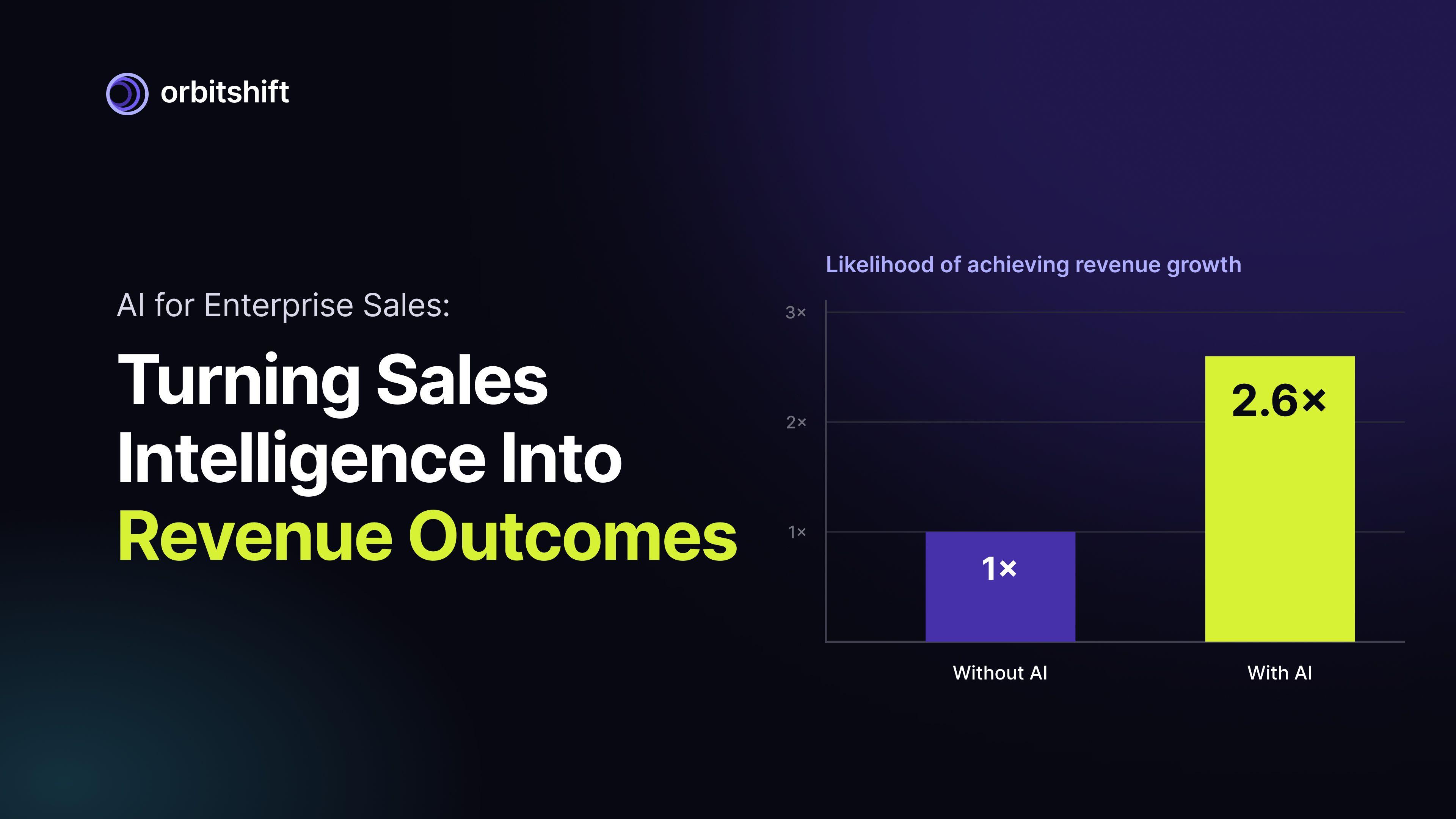
Research indicates that sales organizations that provide AI-enabled next best actions are 2.6 times more likely to achieve revenue growth. But how should you deploy AI within an up and running sales organization? Deploying point solutions can help automate processes but disconnected implementations may struggle to create value across the broader revenue lifecycle. Here are some best practices to consider:
- Start with revenue problems, not AI use cases - Identify the constraints on revenue performance. Find out if the challenge lies in fragmented account information, lack of intelligent insights, poor pipeline inputs, inefficiencies in deal management and align your AI investments with specific commercial outcomes.
- Connect internal and external intelligence - Public information can reveal what is changing within an account, while internal information explains the organization's existing relationship with that customer. Combining the two will create substantially more useful sales intelligence than either can provide independently.
- Build on reliable data - AI cannot compensate indefinitely for incomplete CRM records, duplicated account information or inaccessible organizational knowledge. Organizations need strong data foundations, integrations and governance if AI-generated recommendations are expected to influence important sales decisions.
- Keep sellers in the decision loop - Enterprise sales depends on judgment, relationships and context that may not be completely represented in AI insights. AI is useful for helping sellers see patterns, investigate possibilities and make better decisions rather than automatically determine how every account or opportunity should be handled.
- Integrate AI into existing workflows - An AI system that requires sellers to constantly leave the CRM, collaboration environment or account workflow creates another tool to manage. Adoption is more likely when intelligence appears at the point where sellers already research accounts, prepare for meetings, develop opportunities and manage deals.
The first wave of technology powered sales transformation focussed mainly on digitizing processes and recording activity. AI introduces a fundamentally different opportunity to continuously interpret customer information, markets and opportunities and translate it into intelligence that sellers can act on. It presents unprecedented opportunities for the sales organization to move beyond mere automation, identify revenue opportunities earlier, engage prospects more effectively, make better-informed commercial decisions, and execute complex deals with greater efficiency.