AI Is Rewriting the Economics of IT Services. Is the Sales Model Keeping Up?
October 27, 2026·7 min read
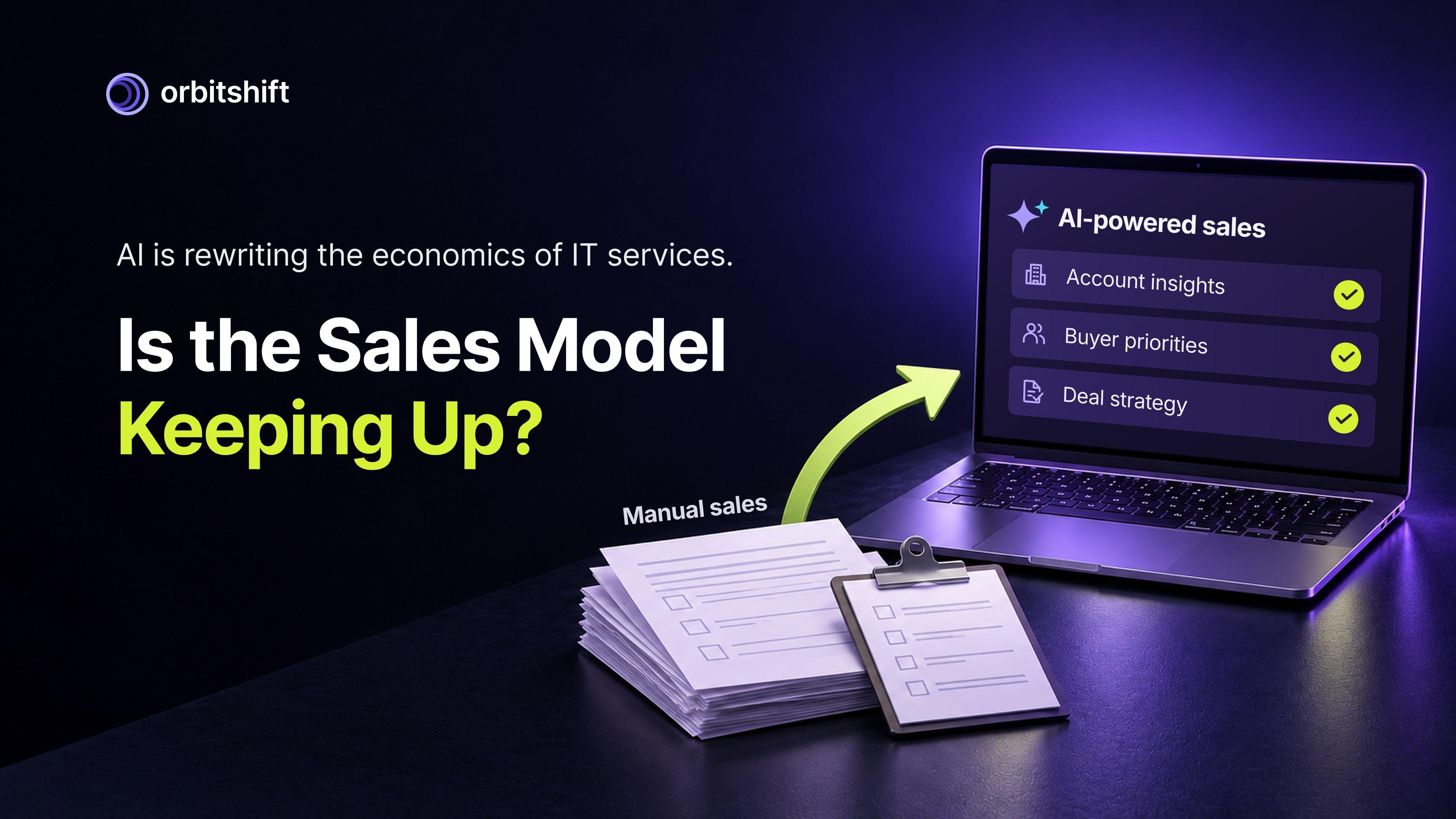
The traditional billable hour is quickly running out of road, and IT services deals are undergoing what may be an irrevocable transformation. It’s not just me saying this. Almost every discussion I had with global IT services leaders at the recent Everest Elevate conference in Dallas touched upon the growing complexity of enterprise deals. They are becoming increasingly focused on business value, taking longer to negotiate and close, and requiring significant coordination and alignment among key stakeholders.
AI is at the heart of this transformation. After all, if AI agents can accomplish in hours what previously required days of human effort, why should customers continue paying for the same volume of resources? The global IT services sector is witnessing a paradigm shift in how companies deliver value, how customers pay for it, and ultimately, how providers generate revenue. Understandably, much of the industry's response has focused on transforming delivery. But the changing value equation of IT services is also driving an urgent rethink of how companies identify opportunities, engage customers and generate revenue.
Why Are Traditional IT Services Revenue Models Under Pressure?
AI is challenging the traditional relationship between headcount, delivery capacity and revenue that has supported the IT services industry for decades. It is shortening contract duration and putting traditional revenue models under pressure. Of course, the sector is already pivoting to address these new challenges by exploring AI-led business models, reworking how they estimate and price work and sharing AI-driven productivity gains with customers. And if recent Q2 FY27 results posted by tech majors like Accenture, Cognizant, HCLTech, Infosys and Tech Mahindra are anything to go by, this shift in strategy is showing promise. According to IDC, by 2029, 30% of global IT services are expected to be delivered as modular, platform-enabled offerings. This shift is being driven by enterprise demand for greater speed and transparency, as well as the growing adoption of generative and agentic AI to automate and orchestrate service delivery.
Interestingly, based on our extensive engagements with the IT services sales ecosystem, we are noticing another significant shift. Many large deals are being renegotiated or renewed with expectations of 40–60% productivity improvements. These are substantial commitments, particularly when the ability to deliver them rests on a combination of "real" levers and "hope" that AI capabilities will continue to mature over the typical five-to-seven-year contract lifecycle. This introduces a new dimension of risk into deal structuring, pricing, and profitability, making it critical for sales teams to align commercial promises with delivery realities.
AI is also transforming the commercial environment within which deals operate and the way the IT sales cycle functions. Buying conversations are now focused on business value, productivity, risk and measurable results. Decision-makers are increasingly AI-informed, and buying circles are expanding to include multiple stakeholders from across functions. Deals are complex and involve value delivery models that are still evolving. Most importantly, AI is also creating opportunities for smaller, more agile providers to challenge established players by adopting new delivery models and responding quickly to changing customer requirements.
Why Do IT Services Companies Need an AI-Enabled Sales Model?
These changes create a dual challenge for the sales organization. On one hand, teams must navigate new revenue models, while on the other, they must ensure higher lead conversion rates. So, while relationships and personal engagement will remain central to the selling journey, reps also need focused sales intelligence, deeper insights into accounts and buyers, and the ability to connect the right buyers to the right offering at the right time. Interestingly, AI also holds the answers to the key challenges facing sales operations today:
Reactive Selling to Proactive Opportunity Discovery - Building a pipeline of qualified leads remains an enduring challenge and top priority for any sales team. There are any number of tools and platforms that provide buyer details and basic account information. But tools alone don’t address the need for actionable insights. For example, a sales representative may have access to extensive information about an account but still struggle to determine whether the customer is preparing for a major technology investment. What reps need right now is timely, actionable intelligence that connects account history, customer priorities, market developments and emerging buying signals.
An AI-powered revenue management platform can address this gap. It can consolidate buying signals scattered across internal and external sources to identify emerging requirements, potential buying stakeholders and opportunities for account expansion. What’s more, it can do all of this in a matter of minutes, leaving sellers free to focus on deal strategy.
Making Account Planning Smarter, Faster and More Dynamic - Account planning remains a broken process in many organizations, largely because creating, updating and managing account plans is tedious and time-consuming. AI can simplify the process of creating and maintaining account plans, but its greater value lies in enriching them with deeper intelligence and context. This can make account planning a more frequent, relevant and valuable exercise for both sales teams and sales managers.
One Deal, Multiple Decision-Makers - IT services contracts are now inextricably linked to business outcomes. As a result, buying circles are now bigger than ever before, with stakeholders from different business units and functions. CIOs and CTOs remain important, but CFOs, business-unit leaders, procurement teams, risk executives and transformation leaders may influence how AI-enabled services are evaluated and purchased. Each brings different priorities, expectations and measures of success to the discussion.
Selling effectively across this buying group requires more than a standard presentation of service capabilities. Sales teams must understand the customer's business context, identify the priorities of individual stakeholders and develop value propositions that connect technical solutions to commercial outcomes. AI can support this process by helping sellers map buying stakeholders, consolidate account intelligence, prepare for executive conversations and develop more relevant engagement strategies.
Replacing Generic Pitches with Contextual Engagement - This is undoubtedly the era of hyper-personalized engagement, and generic sales content cannot deliver revenue outcomes. Every sales conversation must begin with what the customer needs rather than what the service provider has to offer. This requires a deep understanding of the customer's business context, individual stakeholders and their priorities, along with the ability to position relevant solutions and demonstrate credibility through past experience.
Standard corporate presentations, or even AI-enhanced versions of existing sales decks, just don’t pass muster now. AI can help sales teams bring together customer intelligence, stakeholder insights, relevant solution capabilities and past credentials to create highly contextual and relevant sales content.
Taking the Friction Out of Complex Deals - The shift toward value-led selling also increases the demands placed on sales execution. Large IT services deals are increasingly complex, involving multiple teams across sales, delivery, finance, legal and risk. Developing a competitive proposal requires these teams to collaborate on solution design, delivery models, pricing assumptions, performance commitments and governance arrangements. When relevant information is scattered across business units and systems, this becomes a lengthy, resource-intensive process that can delay responses and slow deal progression.
AI can help sales organizations accelerate this process by bringing together enterprise knowledge, customer intelligence and cross-functional inputs. Teams can use AI platforms to respond faster by automating and supporting research, information retrieval and routine coordination, leaving sellers free to focus on solution differentiation, commercial negotiations and building customer confidence.
These challenges don’t exist in isolation and have a direct bearing on one another. An integrated, intelligence-driven operating model can connect account research, prospecting, engagement, opportunity management and proposal development into one seamless function rather than treat them as disconnected activities. This would allow external market signals to inform account planning, account intelligence to guide prospect engagement, customer interactions to influence opportunity prioritization and organizational knowledge to support deal execution.
If AI is fundamentally changing how IT services create and deliver value, the way those services are sold must evolve too. The priority has shifted from mere lead generation, or increasing sales productivity, to building an organization capable of identifying new demand, engaging customers around business value and executing complex deals with greater intelligence and efficiency. That requires a shift from fragmented sales processes toward connected, AI-enabled revenue operations, where human expertise is strengthened by continuous intelligence and more effective execution.