The LLM Data Trap: Why Generic RAG Fails at B2B Entity Resolution
May 20, 2026·6 min read
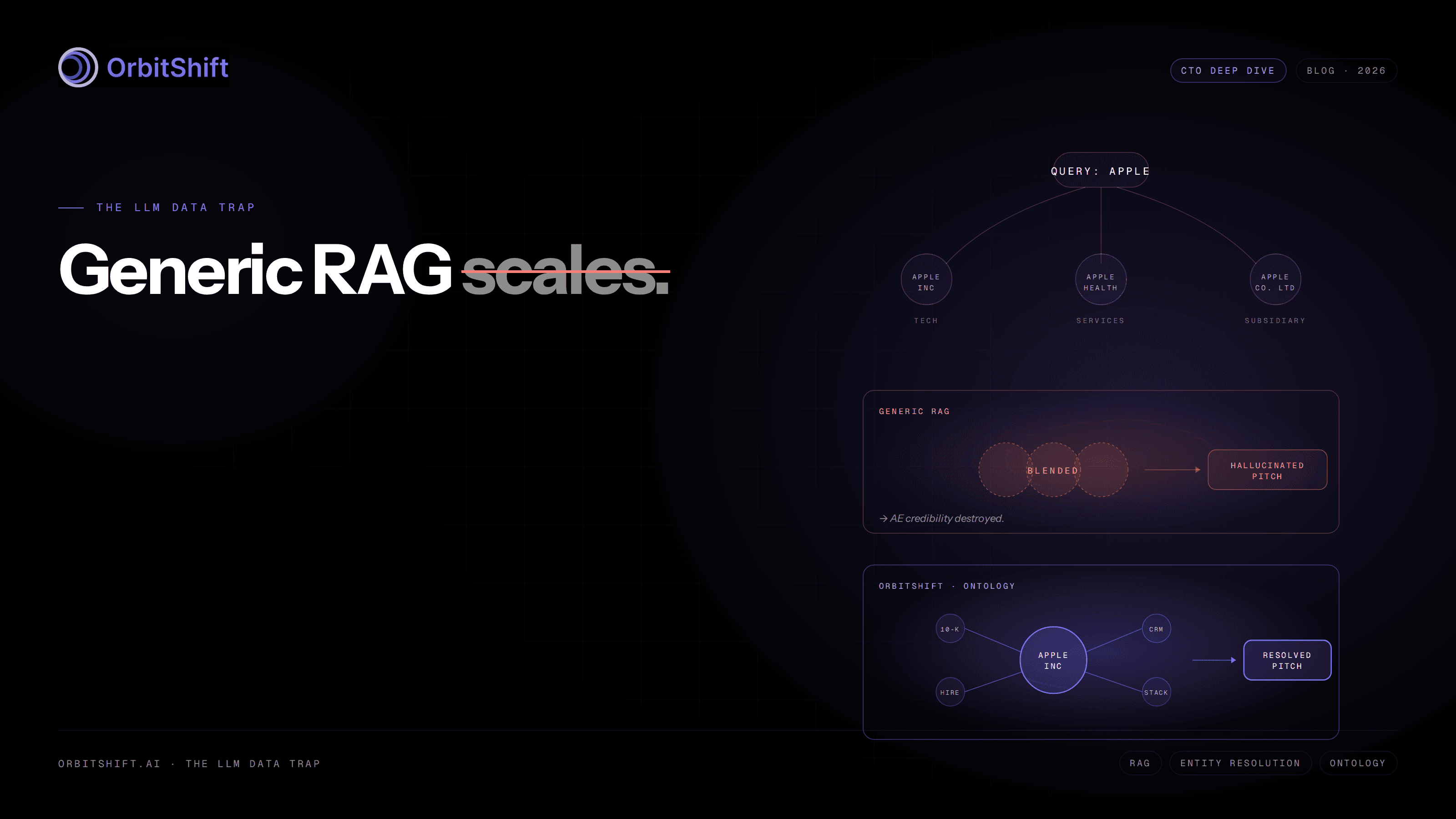
If you are a CTO or RevOps leader tasked with building an AI sales assistant this quarter, the blueprint seems obvious: spin up a standard RAG (Retrieval-Augmented Generation) pipeline, connect a generic LLM via API to your Salesforce instance, and let it summarize data for your Account Executives.
The reality? This "build-it-yourself" approach is a technical trap that will stall your engineering team and burn your sales credibility.
Generic LLMs are brilliant at predicting text, but they are fundamentally blind to the relational architecture of B2B enterprise data. Here is the technical breakdown of why generic RAG pipelines fail in enterprise sales, and why purpose-built infrastructure is the only scalable path forward.
The Technical Chasm: RAG is Not Relational Context
A standard RAG setup fetches text chunks based on semantic similarity. But B2B sales doesn't operate on text chunks; it operates on complex, shifting corporate hierarchies, subsidiary relationships, and timed market triggers. When your internal AI pulls a recent 10-K, an earnings call transcript, and a CRM note, a generic LLM cannot natively map the causal relationship between a newly hired VP and a sudden budget shift.
The Entity Resolution Nightmare
The most glaring failure of the generic wrapper is entity resolution. If your AE asks the internal chatbot for a pitch on "Apple," a generic model lacks the underlying graph database to instantly distinguish whether the context requires "Apple Inc." (tech), "Apple Healthcare" (services), or a subsidiary. The model hallucinates a blended response, forcing the AE to send an inaccurate pitch that immediately destroys their credibility with the buyer.
The OrbitShift Architecture: Pre-Built Ontology
OrbitShift replaces the fragile "wrapper" approach with a robust, domain-specific architecture built specifically for the B2B enterprise motion.
- Domain-Specific Fine-Tuning: Instead of relying on basic RAG, OrbitShift utilizes a proprietary data ontology that natively understands corporate taxonomy. It resolves entities instantly, preventing catastrophic hallucinations.
- Multi-Signal Triangulation: We ingest and structure unstructured data from over 100+ global sources (financials, hiring, tech stack) before it ever hits the generation layer.
- Action Over Summarization: Your engineering team is freed from the endless prompt-engineering sinkhole. OrbitShift outputs a technically flawless, ready-to-execute business intelligence sales pitch, securely and at scale.