Enterprise Sales AI: Why Finding Signals First Isn't Enough
September 10, 2026·7 min read
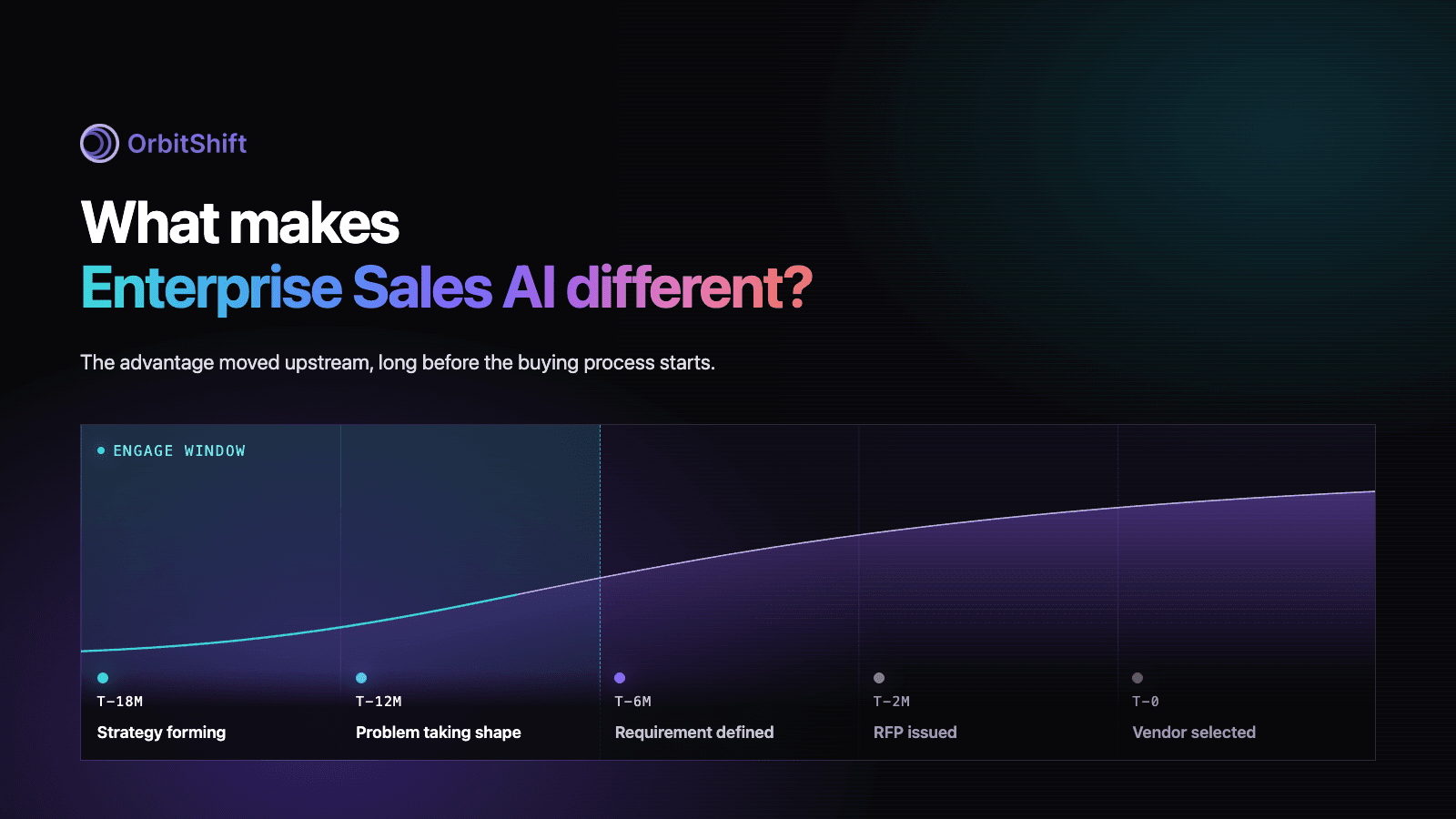
AI has become the new way of working in all fields, including sales. Right from researching accounts and finding prospects, to drafting outreach and recommending next steps. For most part of the sales journey, especially in transactional sales, this works well, but enterprise sales is different and highly complex. The biggest opportunities usually take shape long before a customer starts a formal buying process. Unlike what existing sales intelligence tools tell you, uncovering a signal a few minutes before everyone else does not create much of an advantage in a large enterprise deal with multiple stakeholders.
What matters is understanding where the customer priorities lie, recognizing an opportunity before it becomes an RFP, knowing who will influence the decision, and having a strong problem-offering alignment that gives the customer a reason to engage. This is the gap most Sales AI tools don't close. Enterprise Sales AI has to.
Why finding the signal is becoming commoditized
Most Sales AI today is built around discovery and response: find a signal, identify the right person, generate outreach, move to the next account. These capabilities are useful, but they've already become a standard way of working in sales.
If ten vendors see the same acquisition, technology investment, leadership change, or hiring trend, all ten can identify the relevant prospects and produce personalized outreach within minutes. The research is faster and the message is better written than it was five years ago. But the sales motion is still largely the same. Everyone is responding to the same visible evidence of change.
The more valuable work happens earlier, before the customer has fully defined the requirement. McKinsey found that B2B buyers use an average of 10 interaction channels during their buying journey, with 42% using more than 11. Customers research independently, talk to peers and vendors, compare approaches, and form their own view of the problem well before a formal opportunity shows up in a seller's CRM.
By the time it does, the customer may already have a list of providers they are evaluating and launched an RFP for the same. Sellers who understand where the customer is heading earlier have more time to influence those decisions. That's the core job of Enterprise Sales AI.
How the advantage moves upstream
Most Sales AI systems help sellers respond to something that already happened. Enterprise sellers need something different: help understanding what a series of signals or market trends could mean for their sales strategy..
Take a company announcing a major AI initiative. On its own, that announcement reveals very little about a commercial opportunity. Now add:
- An acquisition
- A change in executive leadership
- Aggressive hiring in a specific business unit
- A new technology partnership
- Pressure on operating margins
- Public comments from the CEO about a strategic priority
Individually, none of these tell you much. Together, they start to tell a real story about where a business is heading and the tools or services they might be needing in the near future..
The same issue shows up in AI-generated sales content. A general-purpose AI tool with access to a company's website, case studies, proposals, and product docs can produce a polished pitch. Producing the pitch is the easy part now. Knowing why a specific customer should care right now depends on a much deeper understanding of the account. Better sales content starts with better customer intelligence, not better writing.
Why enterprise intelligence requires interpretation
Enterprise sellers already have more information than they can use: CRM data, intent signals, company news, analyst reports, call transcripts, account plans, opportunity history, internal documents, executive changes, hiring data, and technology intelligence. However, figuring out how these will collectively influence a deal is the hard part.
As AI takes over more of that research, the value shifts to making sense of the information in the context of a potential customer, and turning that into a point of view a seller can actually use. This is the same shift we've written about in: enterprise sales doesn't have a data problem, it has a decision problem.
This is where generic Sales AI and Enterprise Sales AI start to look very different:
A manufacturer investing heavily in EV production should produce a very different account view than a bank investing in digital channels, even if both announced an AI strategy. Each business has different pressures, stakeholders, and priorities. Enterprise Sales AI needs to recognize which changes deserve attention, connect events that look unrelated on the surface, and translate those connections into a hypothesis a seller can explore with the customer. A seller opening an account doesn't need a complete history of everything that's happened. They need to know what's changing, why it matters to the business, where an opportunity might be forming, and who will influence the outcome.
Intelligence has to become execution
Useful intelligence also has to reach sellers where decisions actually get made. Enterprise sales teams already move between:
- CRM
- Sales engagement platforms
- Research and Gen-AI tools
- Internal documents and meeting notes
- Proposals and account plans
Adding another AI destination just gives sellers another maze to get lost in. It doesn't fix the fragmentation underneath, the same pre-meeting drag and tool sprawl that quietly eats into a seller's week. External intelligence becomes useful once it's connected to the customer context a company already has. A leadership change can be evaluated against the account strategy and open opportunities. A strategic initiative can be tied to the relevant people, offerings, and past conversations. A new investment can be read alongside what the organization already knows about the customer. That understanding also has to reach sellers without requiring clever prompting.
Adoption varies across any sales org with hundreds or thousands of reps, so the important developments need to surface automatically for the people who can act on them. This is what we mean when we talk about making sales intelligence actionable, moving past alerts and into decisions sellers can act on.
Seller capacity makes this more urgent. Salesforce's 2026 State of Sales report found that reps spend 60% of their time on non-selling work. AI can take a real bite out of that. Where that freed-up time goes matters more than the fact that it exists. More emails and faster responses to existing signals make the current motion more efficient. Understanding customers earlier and engaging while priorities are still forming creates more value.
Buyers still want sellers in the conversation. Research suggests 69% of B2B buyers prefer to validate AI-generated insights with a sales rep, and buyers were significantly more likely to credit the rep, not the AI, with helping them understand their needs and feel confident in a decision. Enterprise Sales AI should take work off the seller's plate around the conversation, not replace the conversation.
The new standard for Enterprise Sales AI
Generating an email, summarizing an account, recommending a next action. These are quickly becoming standard Sales AI capabilities, not differentiators. The next generation of Enterprise Sales AI goes further. It needs to help sales organizations understand customers while opportunities are still taking shape.
That starts with:
- Account and people intelligence that shows what is changing inside the customer
- Industry and domain context that helps determine which developments actually matter
- Internal customer knowledge from CRM, conversations, account history, and other sources
- Connected intelligence that brings these pieces together instead of presenting them as separate alerts
- A usable point of view that helps sellers decide where to look, who to engage, and what to explore
The real test is simple: can sellers build a stronger point of view about where they can create value, before the customer has already decided what to buy?
Automation alone won't create much differentiation once every competitor has the same capabilities. The advantage comes from understanding customers earlier, spotting opportunities others miss, and giving sellers the context and the time to engage while priorities are still being formed.
Where OrbitShift fits
OrbitShift is built for executing this approach for enterprise selling. It brings account, people, and market intelligence together with a company's own sales context, so teams can see what's changing inside their accounts, understand which developments actually matter, and spot potential opportunities before they turn into formal buying signals. OrbitShift connects information that would otherwise sit scattered across research tools, CRM records, internal knowledge, and separate workflows, and organizes it around the customer, the people involved, and the opportunities a team could pursue.
Sellers spend less time gathering and connecting information, and walk into customer conversations with a stronger understanding of the account, a sharper commercial hypothesis, and more time to actually influence what happens next.